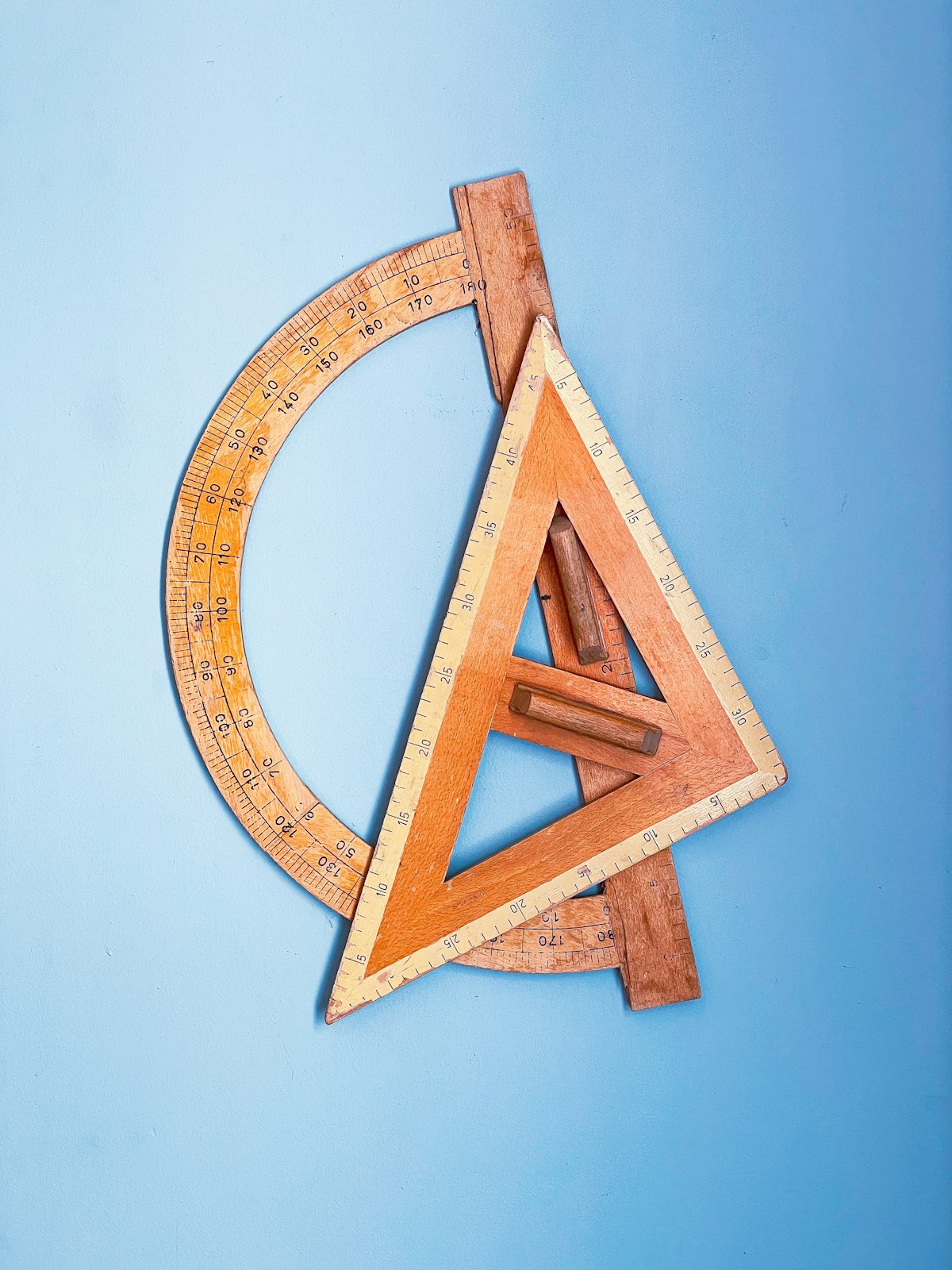

Angles can be measured in degrees, radians, or gradians — three different but interrelated systems. Degrees are familiar from everyday geometry, radians are the mathematical standard used in calculus and physics, and gradians are used in surveying and some engineering contexts. Understanding all three, how they relate to each other, and where each is used helps you work confidently across geometry, navigation, engineering, and trigonometry.
The History of Degrees: Why 360?
The division of a circle into 360 degrees comes from ancient Babylonian astronomy. The Babylonians used a base-60 (sexagesimal) number system and divided the year into approximately 360 days, making one degree correspond to roughly one day's movement of the Sun along the ecliptic. The number 360 has the practical advantage of being divisible by 24 different integers (1, 2, 3, 4, 5, 6, 8, 9, 10, 12, 15, 18, 20, 24, 30, 36, 40, 45, 60, 72, 90, 120, 180, and 360 itself), which made it extremely convenient for fractional calculations in an era before calculators.
What Is a Radian?
One radian is the angle subtended at the center of a circle by an arc equal in length to the radius. Since a circle's circumference is 2 times pi times its radius, a full circle contains exactly 2 pi radians. This geometric definition makes radians the natural unit for angular measurement in mathematics: the arc length of a circle sector is simply the radius multiplied by the angle in radians, with no conversion factor needed. That simplicity is why physics and mathematics favor radians for everything from pendulum motion to electromagnetic waves.
Conversion Formulas
To convert degrees to radians, multiply by pi divided by 180. To convert radians to degrees, multiply by 180 divided by pi, which equals approximately 57.2958. One complete revolution is 360 degrees, 2 pi radians, or 400 gradians. The equivalence 180 degrees equals pi radians is the key anchor for all degree-radian conversions.
Gradians: The Third Angle Unit
Gradians (also called grads or gon) divide a full circle into 400 units, placing a right angle at exactly 100 gradians. Developed during the French Revolutionary metrication effort of the 1790s, gradians were intended to harmonize angle measurement with the decimal system. Surveyors in continental Europe still use gradians because they make calculations with right angles particularly clean. A slope of 1% equals 0.573 degrees or 0.636 gradians. Most scientific calculators include a GRAD mode alongside DEG and RAD.
Key Reference Points in All Three Systems
- Full circle: 360 degrees = 2 pi radians (approx. 6.2832) = 400 gradians
- Half circle: 180 degrees = pi radians (approx. 3.1416) = 200 gradians
- Quarter circle (right angle): 90 degrees = pi/2 radians (approx. 1.5708) = 100 gradians
- Eighth circle: 45 degrees = pi/4 radians (approx. 0.7854) = 50 gradians
- One radian = approximately 57.296 degrees = approximately 63.66 gradians
Why Radians in Mathematics?
Radians make calculus formulas cleaner. The derivative of sin(x) is cos(x) only when x is in radians. In degrees, the derivative becomes (pi/180) times cos(x) — an extra constant factor that clutters every calculation. Similarly, the Taylor series expansions of sine and cosine (sin x = x minus x^3/6 plus x^5/120...) hold only in radians. All trigonometric wave functions in physics, electrical engineering, and signal processing use radians. Every scientific calculator has a RAD mode for this reason.
The Unit Circle
The unit circle is a circle of radius 1 centered at the origin of a coordinate plane. Any point on the unit circle can be described as (cos theta, sin theta) where theta is the angle measured counterclockwise from the positive x-axis in radians. This elegant relationship — where cosine gives the x-coordinate and sine gives the y-coordinate — is the foundation of trigonometry. The unit circle makes it visually obvious why sin(0) = 0, cos(0) = 1, sin(pi/2) = 1, and cos(pi) = -1.
Special Angles and Their Exact Values
- 0 degrees (0 rad): sin = 0, cos = 1, tan = 0
- 30 degrees (pi/6 rad): sin = 1/2, cos = root(3)/2, tan = 1/root(3)
- 45 degrees (pi/4 rad): sin = cos = 1/root(2) approximately 0.7071, tan = 1
- 60 degrees (pi/3 rad): sin = root(3)/2, cos = 1/2, tan = root(3) approximately 1.732
- 90 degrees (pi/2 rad): sin = 1, cos = 0, tan = undefined
Angles in Navigation
Navigation uses bearing — angle measured clockwise from due north, in degrees. A bearing of 090 degrees is due east, 180 degrees is due south, 270 degrees is due west. Ship and aircraft navigation uses this convention. The compass bearing system uses 0 to 360 degrees, not plus or minus 180 as in mathematics. Converting between mathematical angles (measured counterclockwise from the positive x-axis) and compass bearings requires care: bearing equals 90 degrees minus the mathematical angle, adjusted for the correct quadrant.
Angles in Architecture and Construction
Roof pitch is commonly expressed as rise over run — for example, a 4-in-12 pitch means the roof rises 4 inches for every 12 inches of horizontal run, giving an angle of arctan(4/12), approximately 18.4 degrees. Road grade is expressed as a percentage: a 6% grade rises 6 meters per 100 meters of horizontal distance, equivalent to approximately 3.43 degrees. A theodolite — the instrument used to measure angles in surveying — reads in degrees, minutes, and seconds (where 1 degree = 60 minutes = 3,600 seconds of arc).
Angles in Sports
Launch angle is a critical variable in both baseball and golf. A baseball hit at a launch angle of 25-35 degrees tends to produce home run distance if hit with sufficient velocity. Below 10 degrees produces a ground ball; above 50 degrees produces a high, short pop fly. In golf, driver loft angles range from about 8 to 12 degrees for professionals, while irons range from around 20 degrees (long irons) to 46 degrees (9-iron). The optimal launch angle for maximum distance with a golf ball is theoretically 45 degrees in a vacuum, but aerodynamics and backspin shift the practical optimum to around 12-15 degrees for a driver.
Solid Angles: Steradians
A steradian is the three-dimensional equivalent of a radian. While a radian measures a flat angle, a steradian measures a cone-shaped solid angle. One steradian subtends a surface area on a sphere equal to the square of the sphere's radius. A full sphere encompasses 4 pi steradians (approximately 12.566). Steradians are used in radiometry and photometry to quantify light intensity and radiation flux in three-dimensional space. A lamp with 1 candela of intensity emits 1 lumen per steradian in every direction.
For everyday geometry, degrees are natural and convenient. For mathematics, physics, and programming, always use radians. The key conversion: 180 degrees equals pi radians. Memorize pi/6, pi/4, pi/3, and pi/2 as the four special angles, and everything else follows.